


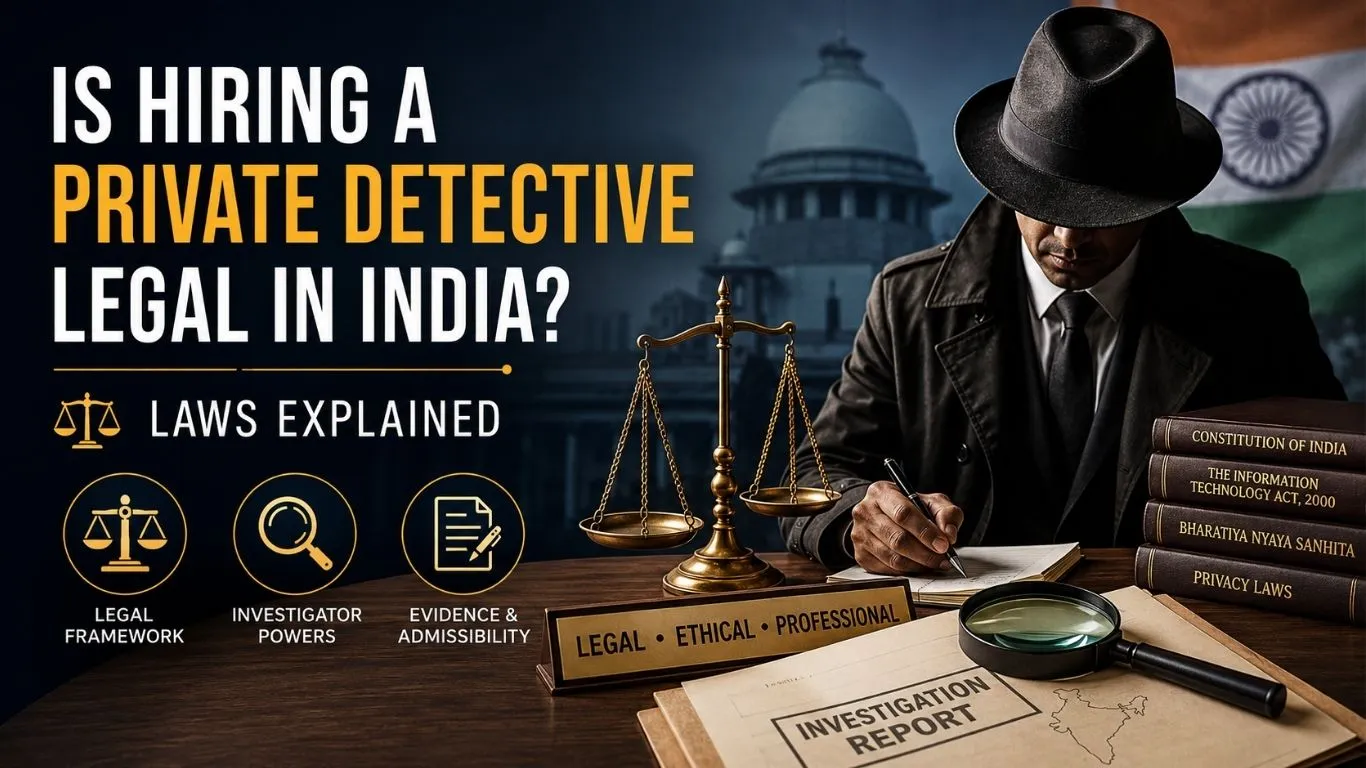

In today’s world, individuals as well as companies seeking to take crucial decisions on the basis of credible information can immensely gain from the services provided by professional detective firms. This might include anything such as searching for missing persons, investigating marital affairs, conducting background checks, investigating corporate fraud, and so forth.
But before hiring a professional detective firm, one needs to ask whether it is legal to hire a private detective in India.
Yes, doing so is quite lawful. As long as all evidence-gathering procedures are lawful and no privacy, criminal, or technological laws are broken, hiring a private investigator is permissible. There are no specific regulations regarding private detectives and investigations in India yet, but professional detective agencies operate in accordance with the relevant legislation.
This guide will explain the legal status of private investigations in India, the legal powers of a private detective, the regulation of surveillance and the gathering of evidence, and other relevant aspects.
Understanding the Legal Status of Private Investigation in India
Perhaps one of the greatest myths surrounding the private investigation industry is the idea that detective services are illegal in India. Such a myth exists due to the fact that India presently lacks legislation governing the licensing of detectives and private investigation agencies.
However, the lack of a licensing statute does not mean that private investigation is illegal.
Private detective agencies are professional service providers who are regularly employed by individuals, corporations, attorneys, and insurance firms for the purpose of conducting legal investigations and verifications. The work of private detective agencies falls under the umbrella of Indian legislation concerning privacy, criminal behaviour, evidence collection, cyber activities, confidentiality, and the rights of an individual.
The legality of a private investigation has less to do with the nature of the profession and everything to do with the process of conducting the investigation itself. Private investigators need to gather evidence in a legally permissible manner; it can be through observation, verification of backgrounds, interviews of witnesses, due diligence checks, and legal research.
Problems will emerge only when such investigation ventures into the realm of legality; for instance, when it includes illegal means such as spying, telephone tapping, hacking, intrusion, or identity theft among others.
As a result, the most important law related to this issue is quite clear: while private investigation is legally permitted in India, the investigative techniques have to be within the confines of the law.
Can You Legally Hire a Private Detective in India?
Yes. It is quite legal to employ a private investigator in India, as long as the investigation is carried out in accordance with all the laws governing privacy, criminal activity, and technology.
Private detectives can be employed by individuals, companies, lawyers, insurance companies, corporations, etc., to help acquire information, confirm claims, estimate risks, and make decisions on the basis of the information gathered. The primary objective behind a private investigation is not to invade one’s privacy but to collect information appropriately.
Private investigation agencies are normally employed for numerous valid reasons, such as:
- Pre marital and Post marital Investigations
- Background verification
- Employee screening and workplace investigations
- Corporate fraud detection
- Business partner due diligence
- Asset verification
- Insurance fraud investigations
- Missing person investigations
- Intellectual property theft inquiries
- Cyber-related investigations
- Internal corporate risk assessments
Whether a detective can be hired or not is not determined by the kind of investigation that will be carried out, but rather by how the process will be done while abiding by the law.
This means that, for instance, one may legally hire a private detective to investigate possible corporate fraud or misconduct among his or her employees. Equally, a person can hire an investigating agency to do a background check before tying the knot in marriage. These will be legal investigations if proper and legal ways of gathering evidence are used.
On the other hand, there will be no means by which the client or the investigating organisation can permit acts such as phone tapping, hacking, trespassing, stealing private information, or tapping into private records.
Thus, it becomes imperative to select a professional and trustworthy detective organisation. Professional investigators know how far they can go according to the law while conducting a private investigation. They strive to obtain accurate and credible information without violating Indian law.
Quick Answer
Can I employ a private detective in India legally?
Yes, a private detective in India can be employed as long as the investigation is being conducted legally and without breaching privacy laws, cyber laws, criminal laws, etc.
Why Do People Hire Private Detectives in India?
A private investigator is hired to get to know about the facts, confirm the information, and eliminate uncertainty prior to any significant decision-making. In some instances, people and companies need confirmation that cannot be easily provided by conventional means.
As life becomes more complicated in the context of personal, business dealings and online interactions, the requirement of professional investigation has risen in India. People usually hire private investigators to gather reliable information or documentation or even evaluation of the circumstances.
Some of the most popular reasons for hiring a private detective in India are:
Matrimonial Investigations
Matrimonial investigation happens to be one of the most highly demanded types of investigative services. Individuals conduct pre- or post-marriage investigations to find out information related to the background of their partner, lifestyle, economic standing, occupation, reputation, and lies.
Background Investigation
It is common for employers, business persons, and other individuals to conduct background checks on the education, previous job experience, identification information, criminal record (where possible), etc., prior to starting their business relations.
Investigation of Corporate Fraud
Private investigation companies can be involved by businesses when there are reasons to suspect any kind of fraudulent activity in the company, such as data leakage, conflict of interest, corruption, financial fraud, etc.
Employee Misconduct Investigation
Workplace investigation is one of the most popular types of corporate investigations, which involves the investigation of possible employee misconduct or violation of workplace rules.
Due Diligence of Business Partners and Vendors
In preparation for large-scale business transactions, a company may employ investigators to investigate the credibility, financial status, reputation, and practices of potential business partners, vendors, or suppliers.
Investigations of Insurance Fraud
Investigators are regularly employed by insurance agencies for claim verification purposes, to detect any cases of possible fraud, and ensure proper payment based on verified information.
Missing Persons Investigations
Families and attorneys often seek help from investigators when it comes to missing persons investigations, where investigators collect information that will help locate a person.
Corporate Espionage and Intellectual Property Investigations
When a company faces issues regarding trade secrets, violation of intellectual property rights, unauthorised disclosure of information, and unfair competitive practices, it may need to hire an investigator.
Cyber Investigations
Due to the increasing number of cybercrimes, investigators can help individuals and businesses collect information related to cyber crime issues such as fraud and abuse of identity.
The Common Goal Behind Every Investigation
Though the situation is different in every case, there is one thing that remains common for all professional investigations: the need to get verified information that will be useful for making decisions. Private investigators perform independent research of facts that can contribute to better decision-making in cases of relationships, business transactions, employment issues, or any other matters.
Example Case Study: Legalities Involved in a Private Investigation Process
The technological company believes that the confidential data of the company may be leaking to their competitor based on the leakage of some of their proposals. In order to get the facts right, they hire the services of a private detective agency.
The private detective studies the publicly available information, looks at relevant business documents provided by the client, performs legal surveillance in public areas, and carries out interviews with those willing to cooperate with him. Throughout the process of the investigation, he avoids engaging in any form of illegalities like hacking of email accounts, tapping phones, obtaining passwords without permission, using spy software, and trespassing on private property.
Once the investigation process is done, the detective produces an investigative report with facts and evidence. This allows the company to make business decisions accordingly.
Main Point: It does not matter who hires the detective since the process of the private investigation itself is legal.
Understanding the Legal Framework for Private Investigations in India
Legal Context for Private Investigation in India
At present, there is no separate law in India that governs private investigations or detectives’ services. In contrast to the situation in other countries, where private investigators work based on licensing laws and regulations, private investigation in India occurs within the framework of general constitutional laws, criminal, privacy, cyber law, and laws governing the gathering of evidence.
Consequently, the legality of the private investigation does not depend on the profession itself, but on compliance with the procedures established in accordance with Indian laws.
It means that any professional detective agency should perform all investigations in a manner compliant with individual rights, privacy protection, and avoiding any actions that could be regarded as criminal offenses and violations of personal privacy.
Some legal issues and documents define the process of private investigation in India.
Right to Privacy under the Constitution of India
“The right to privacy is a fundamental right guaranteed by Article 21 of the Constitution of India”. The aforementioned point has been proven true due to the Supreme Court of India’s ruling in the highly important case of Justice K.S. Puttaswamy.
It implies that any kind of investigative process must not invade into the private sphere of one’s life nor infringe on their privacy rights.
Bharatiya Nyaya Sanhita (BNS)
There are certain regulations in the Bharatiya Nyaya Sanhita (BNS) which are related to criminal offences that may arise during the process of conducting investigations.
Performing any kind of illegitimate acts such as identity theft, forgery, criminal intimidation, cheating, access to classified information, impersonation, etc., may lead to a charge of criminal liability. Hence, it is important that all these aspects should be kept in mind while collecting evidence.
Bharatiya Nagarik Suraksha Sanhita (BNSS)
The Bharatiya Nagarik Suraksha Sanhita (BNSS) refers to the criminal procedures that are implemented in India, which in turn determine the legal aspects of investigations.
Private investigators lack the power that police departments have due to criminal procedures. Hence, they are not able to detain people, search any place, seize things, deliver legal notices, etc.
Their role is limited to lawful fact-finding, information gathering, verification, and documentation.
The Information Technology Act, 2000
The Information Technology Act, 2000 is highly important for contemporary investigations, especially when it comes to digital information.
Illegal access to computers, emails, mobile phones, social media accounts, cloud computing, or any other online information may become a cyber crime in accordance with the laws of India. Professional investigators must not hack, steal passwords, install spy software or perform any other type of illegal access to digital information.
Laws Concerning Evidence and Documentation
Information gained during the course of the investigation can be used as proof for legal or internal actions, disciplinary procedures, insurance claims, and other purposes.
That is why reputable investigators pay much attention to accuracy, documentation, authenticity and proper evidence gathering. Information that is gathered in an illegal way will have to pass legal obstacles.
Concerning Confidentiality
Private investigations often require handling of personal and business information, which may be considered confidential. Professional investigative agencies are expected to provide high levels of confidentiality and proper information handling.
It is necessary to collect only information that is related to the task.
The Core Legal Principle
Although India does not currently have a dedicated statute governing private investigators, the legal position is relatively straightforward:
Private investigations are usually considered legal if done via legal, ethical, and acceptable means.
The biggest concern from a legal standpoint will not be in engaging a private investigator or detective agency, but rather using any illegal method of investigation including hacking, spying, telephone tapping, breaking into premises, fraudulence, identity theft, and accessing confidential information illegally.
Knowledge of these legal concepts helps in engaging professional investigators in a better way, and this will ensure that investigations are done legally according to Indian laws.
What Can a Private Investigator Legally Do in India?
A private investigator is an individual who is supposed to collect information, find out the truth and conduct investigation as well as provide expert advice to his/her client. There is a huge number of actions that private investigators may undertake legally.
Professional detective agencies focus on observing, proving, investigating, documenting and uncovering the truth instead of applying any physical force. The purpose of their activity is to help individuals make the correct decisions based on the correct information.
Perform Surveillance in Public Places
In cases where private investigators need to carry out surveillance on subjects, they are allowed by law to do so in public places as there is usually no reasonable expectation of privacy in such places.
This implies that the surveillance personnel have the ability to monitor individuals engaging in various activities in open spaces when necessary. Open spaces may include streets, parks, shopping centers, restaurants, coffee shops, transportation centers, and many others that are accessible by anyone in the general public.
It is important to state here that all surveillance operations should always be carried out within the legal framework and must never involve any acts of harassment or other forms of illegality.
Perform Background Verification
Background verification is one of the most common services provided by detective agencies.
Investigators may verify information relating to:
- Employment history
- Educational qualifications
- Professional credentials
- Business affiliations
- Publicly available records
- Identity details were legally permissible
- Reputational and Social Background Checks
These kinds of investigations aid people and organisations in evaluating possible risks prior to engaging in any personal, professional, or commercial associations.
Matrimonial Investigations
Private investigators typically help clients in carrying out pre-marital and post-marital investigations.
These may include the verification of information related to lifestyle, occupation, financial standing, behaviour, family background, or any other kind of information that might affect a crucial decision.
Private investigators are supposed to do so in a legal manner and not use any unethical or illegal means.
Interview Individuals Who Agree to Be Interviewed
Investigators can interview individuals who agree to give information about their case voluntarily.
These kinds of interviews, reference checks, and voluntary interviews may be useful in the verification of facts, clarification of certain situations, and obtaining new leads. But investigators are not allowed to force any individual to give information or a statement.
Corporate Due Diligence Investigations
Businesses often engage investigators to perform due diligence before entering into significant commercial relationships.
- This may include verifying:
- Company credentials
- Business operations
- Vendor reliability
- Partner reputation
- Potential conflicts of interest
- Commercial risk factors
These questions lessen an organization’s vulnerability to fraud or financial loss while assisting it in making well-informed decisions.
Examine Corporate Fraud and Employee Misconduct
Organizations may hire private investigators to examine allegations involving:
- Internal fraud
- Workplace misconduct
- Theft of confidential information
- Conflict of interest
- Policy violations
- Unauthorized business activities
Investigators gather factual information and documented observations that assist management in evaluating concerns and taking appropriate action.
Collect Publicly Available Information
A significant portion of professional investigations involves reviewing information that is legally available through public sources.
This may include:
- Public business records
- Court records where accessible
- Government databases available to the public
- Media reports
- Online publications
- Corporate filings
- Publicly available digital information
A successful inquiry frequently depends on the capacity to evaluate and validate material that is accessible to the public.
Record Results and Write Investigative Reports
Keeping correct records and creating thorough reports are two of a private investigator’s most significant duties.
Professional investigation reports may include:
- Verified facts
- Chronological observations
- Supporting photographs where legally obtained
- Witness information
- Documentary evidence
- Risk evaluations
- Investigative conclusions
These reports assist consumers in making well-informed decisions by helping them comprehend the situation’s realities.
What Private Investigators Are Not Able to Do
Private investigators are able to carry out a variety of legitimate investigation tasks, however they are not permitted to:
- Hack computers, phones, or email accounts
- Intercept private communications
- Conduct illegal phone tapping
- Access passwords without authorization
- Install spyware or surveillance software
- Trespass on private property
- Obtain confidential records unlawfully
- Impersonate government officials
- Arrest individuals
- Exercise police powers
The distinction is simple: private investigators may lawfully gather information through observation, verification, research, and documentation, but they cannot violate privacy rights, criminal laws, or cyber laws in the process.
Quick Answer
What can a private investigator legally do in India?
The legal activities that a private detective can carry out include surveillance in public places, background verification, witness interrogation, due diligence investigation, corporate investigation, and matrimonial investigation, among others. They are not permitted to hack into computers, bug phones, trespass, enter confidential files, or exercise police functions.
Can The Evidence Gathered By Private Investigators Be Admitted In Court?
This is perhaps the most popular question our clients raise.
The answer to this question depends on a number of aspects.
In the Indian courts, evidence is usually evaluated depending on its relevancy, genuineness, reliability, and method of collection.
Investigation reports, photos, videos, witness testimonies, and documentary evidence could be used in legal processes if collected lawfully.
But evidence gathered by illegal means might pose problems in terms of its admissibility and reliability.
That is why a good investigator always prefers to gather evidence, which could be admitted to the court in case of necessity.
In situations where an investigation may result in legal proceedings, individuals and businesses may also consider consulting a qualified legal consultant or law firm. Legal professionals can provide guidance on the potential use of investigative findings, explain applicable legal requirements, and advise on the evidentiary aspects of a case.
Common Situations Where People Turn to Private Detectives
Common situations include:
- Suspected matrimonial fraud
- Pre-marital verification
- Corporate fraud investigations
- Employee background verification
- Internal workplace misconduct
- Financial fraud
- Intellectual property theft
- Business partner due diligence
- Missing person inquiries
- Insurance investigations
- TSCM Bug Sweeping
Professional investigations help clients make informed decisions based on documented facts instead of speculation.
Popular Myths About Private Investigation Industry in India
There are certain myths that people have regarding the private investigation industry. Understanding some facts is crucial.
Myth: Hiring an investigator is illegal.
Fact: Hiring a private investigator is not illegal.
Myth: Your mobile phones and social media accounts are accessible via a detective without legality.
Fact: Accessing your mobile phones and social media accounts through investigators is prohibited.
Myth: Private Investigators have police powers.
Fact: A detective agency is a private company which cannot arrest anyone or conduct any search.
Myth: All reports of investigation are admitted to the court.
Fact: The courts admit only relevant, authentic and legal evidence.
How To Choose a Good Detective Agency?
Not all detective agencies follow the same standards of professionalism.
Some points to remember while selecting a detective agency:
- Business credential of the detective agency.
- Experience of the detectives.
- Legal approach in the course of investigations.
- Policies of confidentiality.
- Reporting policy.
Do not select those agencies which promise you to conduct any illegal surveillance or guarantee the result of their investigation.
Why It Is Important To Choose an Ethical Detective Agency
It is known that professionals are aware of the importance of not only finding information, but also acquiring it according to law.
Thus, an ethical detective agency will use proper methods of investigation, provide confidentiality for its clients, respect people’s rights, and not use any illegal ways of conducting an investigation.
Choosing the right agency will increase the chances of getting credible, professionally obtained information that can be used both personally, for companies, and legally.
Private Detectives vs Police: What’s The Difference?
One of the major misunderstandings regarding private investigators is the assumption that they have the same powers as police officers. However, it should be noted that the work of private detectives and police officers differs significantly from each other.
Private investigators conduct investigations and obtain information according to the law at the request of individuals, companies, lawyers, or any organisations. On the other hand, police officers are government authorities who are responsible for law enforcement, investigation of crimes, keeping order in society, and exercising powers according to law.
| Private Detective | Police |
| Operates as a private professional or agency | Operates as a government law enforcement authority |
| Hired directly by clients | Acts under statutory authority and legal mandates |
| Conducts fact-finding and information gathering | Investigates criminal offences and enforces the law |
| Cannot arrest individuals | Can arrest individuals where authorized by law |
| Cannot conduct official searches or seizures | Can conduct searches and seizures under applicable legal procedures |
| Cannot compel individuals to provide information | May exercise legal powers during official investigations |
| Relies on observation, verification, research, and documentation | Utilizes investigative powers granted by criminal procedure laws |
| Has no police powers | Possesses powers granted by law |
Key Takeaway
Private detectives are not law enforcers and do not have any police powers. They can only gather information legally, verify information, conduct surveillances lawfully, and conduct investigations for their clients.
While a detective firm can assist in uncovering facts, identifying risks, verifying information, or conducting a lawful investigation for business and legal decisions, only authorized governmental agencies can conduct investigations, searches, arrests, prosecutions, and compulsory investigations.
Knowledge of the distinction between private detectives and law enforcing authorities enables one to know what needs to be done in certain situations.
Conclusion
Private investigation plays a crucial role in aiding people and organizations in verifying facts, reducing risks, and making good decisions. Though India lacks any specific law for private detectives, hiring a private detective becomes lawful in case of following the procedures set by laws.
The main difference is not the legality of private investigation but the legality of the way of investigation.
In any case, hiring a private detective in India is usually legal if the process is lawful. Hiring a detective agency that uses ethical and lawful investigative methods is your best choice.
FAQ’s
Is it legal to hire a private detective in India?
Yes, hiring a private detective in India is legal, but this has to be done within the ambit of the law and through legal processes.
Is it legal for a detective to track someone’s phone?
No, using someone’s mobile phone in India without the aid of a court order by a private investigator is an illegal act.
Can email accounts or WhatsApp accounts be hacked by private investigators?
No, hacking into private email accounts and WhatsApp is considered an illegal act in India.
Are detective reports admissible in court?
However, it is dependent upon the court’s decision about the admissibility of the same in that case.
Is it possible for companies to employ private investigators?
Yes, companies employ private investigators to help in investigating matters such as the misconduct of employees and any fraudulent activity.
Is it always legal to conduct surveillance?
No. It is dependent upon many factors including the way it was done and whether or not it violates the right of someone else.
Can a detective obtain bank records or call records?
No. Private investigators cannot legally obtain confidential bank records, call records, or other protected personal information through unauthorized means. Such access is restricted under applicable laws.
Are private investigators allowed police powers?
No. They have no power to make arrests, conduct search operations, or perform any other actions as law enforcers.
How to find a good detective agency?
The best way to find a good agency is to choose those with experience in investigation of similar matters, using a proper investigation procedure, maintaining confidentiality, having a good reputation among customers, and investigating the issue legally.
Is there any law on private detectives in India?
There is no special law regulating activities of private detectives in India. The activities of these persons are regulated by constitutional provisions and laws on criminal acts, privacy, information technologies, and evidence.
Is it legal to record a conversation in India?
It is not always legal to record a conversation in India, as this act can be viewed as interference with someone’s privacy. It is better to avoid any unlawful interception or recording techniques.
Are private detectives allowed to investigate the matrimonial issue?
Yes, detective agencies usually carry out both pre-marital and post-marital investigations as long as their investigation technique stays legal and respects the privacy of all people concerned.
Disclaimer: The presented information is general in nature and cannot be viewed as legal advice.