

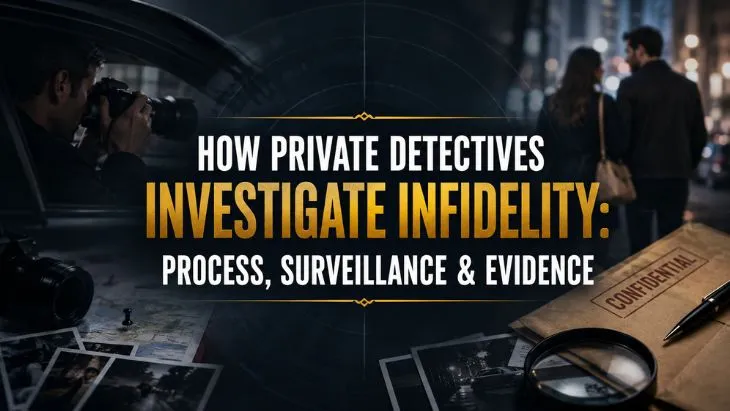

The feeling of having one’s partner unfaithful might be the source of another special kind of uncertainty. After all, while changes in behaviour are often significant, feelings and patterns cannot be considered facts. In most of the cases, when couples dispute, the hardest part is not the fact of the feeling of suspicion but rather the lack of clarity about what really took place and where and when and with whom.
Infidelity investigation is done to make the situation less speculative through the use of an organised procedure. This procedure includes the case analysis, the examination of the legally available information, surveillance (if necessary), precise documentation and observation corroboration. The point is not to prove any story but simply to document the observable and verifiable.
In this article, we describe the process that the professionals working in private investigation agencies in India will go through in order to investigate cases of suspected infidelity.
What Is an Infidelity Investigation?
Infidelity investigation is a type of private investigation whereby the client needs answers regarding his spouse’s or partner’s behaviour—most of which are related to finding out whether there is a love affair, secret meetings or travel, and other secrets.
People seek professional assistance for many reasons, such as:
- Ongoing confusion due to inconsistent explanations or missing time
- Matrimonial disputes where clarity matters for personal decisions
- Concerns about safety, coercion, or hidden associations
- A need for objective documentation rather than arguments or assumptions
The job of an investigator is only to observe, record, and report, rather than preaching morality or pressuring his/her client into making certain decisions and forming conclusions. This is because such investigations involve sensitive issues, which is why secrecy and discreet handling become the key aspects of a valid investigation.
In India, such investigations fall into a broader ambit known as matrimonial investigation, which involves both pre- and post-marriage verification, behaviour verification, and relationship verifications, among others. (If you want the broader context, see Spy Detective Agency’s page on matrimonial investigation services.)
What Makes a Professional Infidelity Investigation Different?
Most begin with observation of themselves—they observe the timelines, changes, ask questions, and look through the Internet or social media accounts. It can seem logical, but it usually gets too emotional and legally dubious.
A professional approach is different in several practical ways:
Personal suspicion vs. professional investigation
Being late to come back home or being secretive may arouse suspicions. An investigator will break down everything and build up an investigation from factual information: factual information on dates, locations, habits, and statements for verification.
Observation vs. interpretation
Seeing someone meet another person is an observation. Concluding it is an affair is an interpretation. Professional reporting distinguishes the two and avoids turning impressions into “facts.”
One incident vs. corroboration
A single observation might be misleading. Investigators seek out patterns, timelines, repeated meetings, and consistency day after day, for that is how they draw reliable conclusions.
Informal monitoring vs. structured surveillance
Professionally planned surveillance is not “following someone around.” It involves case-specific planning, lawful positioning, accurate logs, and continuity—while minimising risk and avoiding unnecessary intrusion.
Assumption vs. documented evidence
A credible investigation produces a clear record (where possible): dates, times, locations, movements, and relevant interactions—documented in a way that can be reviewed calmly later.
Just as importantly, legitimate agencies work within legal boundaries. If a proposed method involves hacking, unlawful interception, or trespass, it is a red flag—not a “shortcut.”
When Should You Consider an Infidelity Investigation?
There are various reasons behind the behavioural shifts in people including stress, illness, job related, money worries or family issues. These behavioural changes do not necessarily indicate infidelity; however, these could be the reason to look for information.
Sudden Changes in Routine
Examples include new “late office” patterns, unexplained schedule shifts, or frequent last-minute plan changes.
Unexplained Absences or Travel
Repeated travel with vague details, inconsistent itineraries, or missing availability can create uncertainty—especially when explanations don’t match observable constraints.
Communications Red Flags
A sudden desire for secrecy, changing passwords, and not making regular calls could be problematic; however, such red flags may exist even outside of romantic relationships.
Social/Financial Red Flags
Unexpected costs, withdrawals from an account, or a new membership or venue could pose some red flags—especially if you receive inconsistent explanations.
Information That Does Not Match
This is often the tipping point: when what someone says (where they were, who they met, why they travelled) repeatedly fails to align with other reliable information.
The professional lens here is simple: these are reasons to verify, not reasons to conclude.
How Private Detectives Conduct an Investigation for Suspected Infidelity
The process of conducting an investigation in suspected cases of infidelity follows a set pattern, although the details may differ. Here is a typical professional process that may be followed:
1. Initial Consultation and Case Assessment
This is where the investigator determines what the client actually needs—and whether an investigation is appropriate.
A proper consultation usually covers:
- The client’s concerns and what triggered them (without escalating assumptions)
- A clear investigation objective (e.g., verify claimed travel, identify regular meeting locations, confirm or refute specific patterns)
- Information the client already has (messages shared voluntarily, receipts, known addresses—without pressuring unlawful access)
- Known routines: working hours, typical routes, usual weekend patterns
- Specific dates that matter (anniversaries, “work trips,” recurring late nights)
- Ethical and legal limits—What is possible by law and what is not
- Hazards and limitations (children involved, safety issues, delicate work environments)
A professional investigator should also be willing to say: surveillance is not always necessary. In some matters, background verification or open-source review may answer the question more proportionately. (Related: background verification services.)
Practical note: vague goals (“I just want to know everything”) often lead to wasted time and cost. Clear objectives keep the work proportionate and focused.
2. Background and Open-Source Information Review
Before anyone considers physical surveillance, investigators often start with lawfully
accessible information—especially to confirm identifiers, locations, and likely routines.
This may include:
- Public social media content (posts visible without logging into someone else’s account)
- Publicly available web information related to known businesses or affiliations
- Client-provided information (shared voluntarily)
- Verification of known locations (e.g., whether a stated venue exists and matches claimed timings)
If digital verification is relevant, some clients prefer a dedicated scope such as social media verification or, where appropriate, a broader cyber investigation.
Important line: Good investigators must not get information via any kind of unauthorised access—no hacking of accounts, breaking passwords, or intercepting private messages. If someone offers that, you are not looking at a professional service.
3. Investigation Planning and Reconnaissance
Surveillance (when required) is planned—not improvised. Planning reduces error, cost, and unnecessary exposure.
Investigators typically plan around:
- The objective (what must be verified, and what is irrelevant)
- Relevant locations (work area, common meeting zones, specific venues tied to claims)
- Timing windows (days and hours where verification is most likely)
- Transportation and feasibility (traffic patterns, parking constraints, safe observation points)
- Case risks (safety, likelihood of misidentification, sensitivity of certain sites)
This stage may include limited reconnaissance—at a high level—to understand the environment and reduce mistakes during actual surveillance.
Why this matters: many “false alarms” come from poor planning—wrong vehicle identification, confusing similar-looking buildings, or assuming routines without testing them.
4. Discreet Physical Surveillance
Professional matrimonial surveillance should be conducted from locations and in circumstances where the investigator is lawfully entitled to observe, without trespass, harassment, or unlawful intrusion.
At a high level, surveillance may involve:
- Observing arrivals and departures from lawful vantage points
- Maintaining appropriate distance to avoid disruption
- Recording relevant movements and meetings without interfering
- Keeping continuity through accurate logs
- Using additional investigators when needed for continuity (for example, to avoid gaps when the subject changes direction or to cover multiple exits)
A professional investigator avoids unnecessary interaction. The goal is documentation, not engagement.
Surveillance is also used in other types of private investigations where establishing a person’s movements or activities is relevant.
Clear limitation: surveillance is not a license to enter private property, place devices in someone’s home, or record private communications. Legitimate surveillance is careful about boundaries because boundary violations can compromise both ethics and usefulness.
5. Documentation and Evidence Collection
Documentation is where the professionalism of the investigation process begins to show. Effective documentation helps one review facts at a later time without having to depend on one’s memory or feelings.
Typical documentation may include:
- Date, time, and location stamps
- Start/end times for surveillance windows
- Movement logs (where the subject went and when)
- Observable meetings or interactions (without adding assumptions)
- Photographs or video where legally appropriate and safely obtained
- Chronological case notes written consistently
Why are timestamps and context important? An image with no context can be misleading. A good documentation gives the background to events before and after, their duration, and whether they fit or contradict an alleged narrative.
A professional report also distinguishes:
- Observed facts (e.g., “Subject entered X building at 7:42 pm”)
- Reasonable identifiers (e.g., vehicle registration observed)
- Non-factual impressions (kept out of conclusions unless clearly labelled)
6. Corroborating Information
Corroboration is what separates reliable investigation from storytelling.
Professional corroboration may involve:
- Cross-checking observations across multiple days
- Comparing claims (e.g., “work meeting”) with observed locations and timings
- Building a timeline and checking consistency
- Identifying patterns (e.g., the same venue weekly, the same individual appearing repeatedly)
- Avoiding “single incident conclusions”
Key point: the goal is verification, not confirmation. A credible investigator is willing to conclude that available observations do not support the suspicion—or that evidence is inconclusive within the agreed scope.
7. Investigation Reporting
A professional final report is designed to be readable, chronological, and objective.
A report may include:
- Case overview and scope (what was asked, and what was not)
- Investigation dates and time windows
- Chronological observations (clear, factual writing)
- Relevant photo/video stills or references where appropriate
- Supporting notes (vehicle details observed, locations, identifiers)
- Any limitations encountered (gaps due to traffic, denied access to private areas, weather, etc.)
It should not include sensational language, moral judgments, or pressure about what the client “must do” next.
Anonymised examples (composite scenarios)
Example 1: Verifying a travel claim
A client is told their spouse is travelling for work twice a month. The investigation is not about finding out if there is an affair; rather, its purpose is to establish whether or not travel takes place as said and the timeline is accurate. The use of surveillance and location verification will prove that indeed the individual travels but not in the manner stated..
Example 2: Repeated “late office” pattern
A client reports frequent late nights. The investigation plan focuses only on a few high-probability evenings. Documentation may show the subject leaves the office at a normal time and spends extended time at a café with a particular individual. On its own, that may not “prove” infidelity, but it can verify the mismatch between claims and behaviour, supported by a clear timeline.
Example 3: Social media contradictions
A spouse claims to be out of town. Public posts from a connected social circle suggest a local gathering the same day. Open source investigation can limit the scope of surveillance in terms of expense and specificity without exceeding legal boundaries.
What Type of Evidence is Obtained From an Infidelity Investigation?
Depends on circumstances and legal limits. Not every case yields the same type of documentation, and not every observation is recordable.
- Photographic Proof: Photographs can show presence at a certain place, meeting, or movement—if photographed from legal angles and when it is legal to take such pictures.
- Video Proof: Sometimes video clips are more revealing than still pictures because of their sequence and continuity. Collection must still respect legal boundaries and situational constraints.
- Activity Logs: In cases where media footage may not be available, an extensive log of activities (times, locations, movements) tends to form the basis of the report.
- Timed-Based Observations: Having a timeline can be just as valuable as having photos, especially for corroborating discrepancies in the schedule claimed by someone.
- Publicly Available Digital Information: This may include public posts, public profiles, or publicly visible events. It does not include private chats, locked accounts, or accessed-without-permission data.
- Supporting Background Information: Depending on the scope, this may include verification of addresses, businesses, or affiliations using lawful methods.
Legal qualification (important): whether any particular material can be relied upon in legal proceedings depends on multiple factors—how it was obtained, authenticity, relevance, and the court’s assessment. For electronic material, Indian courts often look closely at authenticity requirements (including, where applicable, certification requirements under the Indian Evidence Act for electronic records).
How Surveillance Can Confirm Suspected Infidelity
Surveillance can confirm specific questions since surveillance provides a record of observable reality over time:
- Movement patterns (where people go and how often)
- Meetings and repeated associations (observable, not inferred)
- Locations and timelines (whether claims align with movements)
- Duration of visits (minutes vs. hours can change interpretation)
- Consistency across multiple days
Surveillance supports clarity. It does not automatically establish infidelity, and it should never be framed as such.
What Private Detectives Cannot Legally Do
Privacy has been acknowledged to be a fundamental right in India by the Supreme Court of the country. This more general principle that has been established by the constitution forms an important background against which one must look at the issue of surveillance and the management of personal data.
Legal investigators must not employ or suggest any illegal procedures that include:
- Hacking emails, social networking sites, and bank accounts (hacking is an offence covered by the Information Technology Act, 2000)
- Tapping into private conversations or messages without proper legal authority (tapping is strictly regulated and cannot be done by private individuals)
- Using spyware or surveillance software without authorization/consent
- Unauthorized GPS tracking through illicit means
- Breaking into homes, hotel rooms, offices, or private property (trespass/house-trespass and related offences)
- Obtaining protected records unlawfully (bank, telecom, medical, etc.)
- Impersonation to illegally access records or restricted areas
A reputable agency will explain what is feasible within lawful limits, and will not “sell” illegal certainty.
In some cases of marriage disputes, one might worry about privacy invasion through hidden cameras, eavesdropping, covert monitoring, or electronic surveillance. In such instances, a thorough TSCM and bug sweeping inspection by a competent professional is the solution to identify any possible risks of surveillance. Where there are any doubts regarding the presence of hidden listening devices, cameras, or monitoring, the reader will also find our TSCM and bug sweeping services useful.
How Long Does an Infidelity Investigation Take?
There is no single standard duration. Time depends on what must be verified and how predictable the subject’s routine is.
Common factors include:
- The investigation objective (single event verification vs. long-pattern documentation)
- How routine-based the subject’s movements are
- Number of locations and travel distances involved
- Whether surveillance is required and for how many windows
- Availability of reliable starting information (correct address, vehicle, schedule indicators)
- Complexity: multiple cities, irregular hours, or high-traffic environments
An experienced private investigator would offer the scope of the investigation in stages so that the client is able to make a judgment on the progress made and whether more investigation is necessary.
How Much Does an Infidelity Investigation Cost?
The prices charged by the agencies will vary greatly, and it should be quoted only after assessing the scope of the case. It is a red flag if any agency gives a quotation without asking you some basic questions.
Common cost drivers include:
- Number of surveillance hours required
- Whether one or multiple investigators are needed for continuity
- Travel distance, inter-city work, and local logistics
- Complexity of the environment (multiple exits/venues, irregular movement)
- Reporting requirements (detail level, formatting, media handling)
- Duration and frequency (a few targeted windows vs. repeated observation days)
Instead of looking for a “package,” it’s usually more useful to ask for a case-specific estimate after an initial assessment. (Related reading: private detective cost factors / investigation cost guidance.)
No prices are listed here because accurate pricing depends on scope and logistics.
Can Private Detective Evidence Be Used in Court?
Sometimes it can—but there are important caveats.
Important factors to consider include:
- Legal acquisition: Materials acquired illegally may pose major problems, both legally and in terms of their admissibility as evidence.
- Legitimacy: It is possible that the court will ask for proof that material is legitimate and has not been tampered with.
- Relevance: Evidence must have relevance to the matters before the court.
- Documentation: Proper timelines and identification.
- Court’s discretion: admissibility is determined by the court based on applicable law and facts.
For electronic records, Indian legal practice often involves compliance requirements under the Bharatiya Sakshya Adhiniyam, 2023 (including provisions relevant to electronic records). When litigation seems to be in the offing, it will be prudent for you to talk to your attorney early on regarding the evidence process so that the investigation documentation process will meet the requirements of the law without violating it.
What Should You Provide to a Private Detective before an Investigation?
A client typically helps by sharing:
- Full name and basic identifiers of the subject (avoid guesswork)
- Recent photographs (to prevent misidentification)
- Addresses which are known (home, work, frequent destinations)
- Information about the vehicle (type, color, plate number if known)
- Routine information (office hours, gym schedule, fixed weekly appointments)
- Relevant dates (recurring late nights, travel dates, events that triggered concern)
- Any existing documentation you already lawfully possess (receipts shared with you, public posts, etc.)
- A clear objective: what you want to verify (and why)
In addition to that, refrain from conducting any illegal surveillance by yourself because besides being a legal hazard, it can be detrimental for you emotionally and can also hamper the prosecution of the case.
What Happens After the Investigation?
A proper closeout will normally follow this pattern:
- The investigation terminates at the achievement of the objective, completion of the scope, or termination of the assignment by the client.
- Notes and logs are sorted in chronological order.
- Observations are analyzed for consistency.
- A final report is prepared with factual findings and supporting documentation.
- The client receives the report and decides what to do next—privately, calmly, and in line with their personal and legal situation.
An ethical investigator will not push the client to become confrontational, nor give legal advice. Where there is any thought of legal involvement, the client is advised to see a competent attorney.
Mistakes People Commonly Make While Investigating Their Spouses on Their Own
These kinds of mistakes happen regularly and can even make the problem more difficult.
- Confrontation at an early stage: Denial will happen, making the problem worse or changing behaviors to make it harder to understand.
- Using social media as proof: posts can be misunderstood, outdated, false, or out of context.
- Following personally: it increases emotional strain and can create safety or legal issues.
- Attempting unauthorized access: hacking, password guessing, or “checking” private messages can create criminal liability.
- Installing tracking/monitoring software: spyware and unauthorized tracking can be unlawful and can seriously harm your legal position.
- Good behavior wrongly interpreted: Stress, burnout, or problems at home could be perceived as “suspicious behavior.”
- Tampering with possible evidence: Anything that will destroy the context like tampering with the device, deleting messages, or altering accounts.
- Emotionally reacting to the situation: This restricts your perception and makes the objective data into “certainty.”
Why Choose a Professional Private Detective for an Infidelity Investigation?
A professional investigator brings structure to a situation that often feels chaotic:
- Clear objectives and proportionate scope
- Discreet handling and confidentiality-aware workflow
- Lawful methods and privacy boundaries
- Objective documentation that separates observation from interpretation
- Reporting that is chronological and reviewable
If you are looking for confidential support in India, Spy Detective Agency handles sensitive matrimonial matters as part of its broader investigation services, including matrimonial investigations, post-matrimonial investigation support, and surveillance investigations. For region-specific availability, you can also refer to the agency’s Delhi office/service page if your concern relates to Delhi/NCR.
Frequently Asked Questions
How can infidelity be investigated by a private investigator?
Some of the standard procedures include holding consultations, researching through the legal process for any relevant data, planning, conducting covert investigation if needed, documentation, verification of facts gathered, and preparing an unbiased report.
How long does an infidelity investigation take?
It depends on the objective and the subject’s routine. Some matters require only a few targeted surveillance windows; others need longer pattern verification. Legitimate agencies avoid “guaranteed timelines.”
How much does an infidelity investigation cost?
This is dependent on the amount of time spent conducting the surveillance, the number of investigators needed, logistics for carrying out the operation, complexity of the assignment, and type of report required.
Can a private detective conduct surveillance legally?
Yes—when conducted from lawful locations and without trespass, harassment, or illegal interception. Legitimate surveillance focuses on observable activity and respects privacy boundaries.
What evidence can a private investigator collect?
Common outputs include surveillance logs, timeline notes, and photographs/video where legally appropriate, plus public/open-source information relevant to the case scope. The exact evidence varies by circumstances.
Can social media be investigated?
Information available publicly is accessible for review. Professionals should avoid trying to override privacy settings and gain access to accounts without permission.
Can evidence from private detectives be presented in court?
Sometimes, but admissibility depends on lawful collection, authenticity, relevance, and the court’s assessment. Electronic evidence may require specific handling under the Indian Evidence Act. Consult a lawyer for your situation.
Is an infidelity investigation confidential?
Reputable agencies treat matrimonial matters as sensitive and limit access to case information internally. Ask directly about confidentiality practices, reporting format, and how records are stored and shared.
Final Thoughts
Suspected infidelity can be emotionally exhausting precisely because uncertainty invites interpretation. But personal interpretation—no matter how intuitive—does not substitute for verifiable facts. A credible infidelity investigation is not about pushing a conclusion. It is a structured effort to establish clarity through lawful information review, discreet surveillance when justified, careful documentation, corroboration, and objective reporting.
If you are considering a matrimonial investigation and want to understand what is realistically possible (and what is not), a confidential consultation can help you define a clear objective and a proportionate scope—without assumptions and without pressure. You can reach Spy Detective Agency for discreet guidance and next steps if professional verification would help you make calmer, informed decisions.
If you are looking for a matrimonial or infidelity investigation in Delhi and NCR region, then the following guidelines will prove beneficial for you as well.