


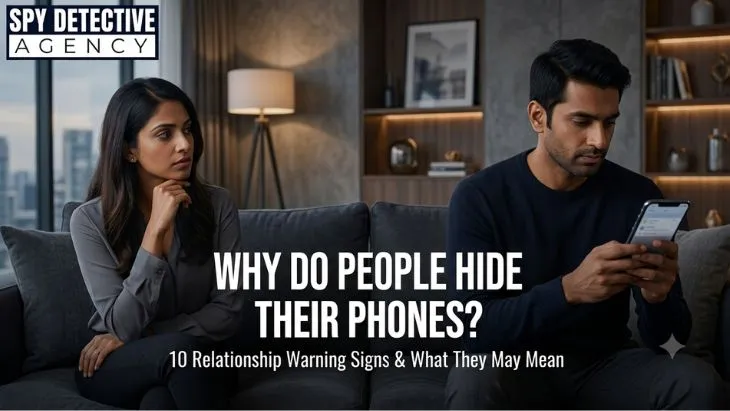

Smartphones are not just about text messages. They carry private conversations, social networking sites, pictures, apps that help you pay bills or do bank transfers, work communications, your location data, and personal memos. Since today’s world is revolving around such an object, keeping it secretive within a relationship takes on a psychological connotation, especially if your partner catches you doing it suddenly.
That being said, just having your phone private does not imply cheating. It is totally okay to have some privacy in a relationship, and just one instance of it (for example, turning your screen around) does not indicate any kind of deception. The key here is pattern + change + context.
Below are 10 common warning signs people associate with a partner hiding their phone—along with what each sign may mean, including innocent explanations.
Why Phone Secrecy Can Affect Trust in a Relationship
There is an intimate connection between phones and relationships – plans, pictures, money matters, family talk, and communication all around. If something about your partner’s phone use changes suddenly, then it can bring uncertainty, because it upsets the “normal.”
A helpful way to frame this is:
- Privacy: acceptable boundaries for oneself (journal applications, private business communications, conversations with friends).
- Secrecy: hiding of information which might have an impact on the relationship (continuous hidden communication, lies, or contradictory statements).
One and the same act may mean privacy in one relationship and secrecy in another (e.g., locked mobile phone). Even context matters more than the phone itself.
Reasons Why People Hide Their Phone
Before jumping to conclusions, consider some legitimate reasons why someone may become more protective of their phone—many of which have nothing to do with cheating:
- Private conversations in regard to work (clients, law-related, HR-related, NDAs).
- Planning something surprising (gift, marriage proposal, vacation).
- Family stress they aren’t ready to share (health issues, conflicts, financial requests).
- A longstanding preference for digital privacy (past experiences, personal boundaries).
- Planning finances (pay off debts, budgeting, investments, therapy).
- No interruptions while working or discussing important matters (mute mode, focus mode).
- Security concerns (new scam attempts, hacked account fears, phone theft risk).
Key takeaway: Phone privacy by itself does not indicate cheating or dishonesty.
10 Relationship Red Flags and Their Possible Implications
1) They Suddenly Change Their Phone Password
What you may notice:
- Password changes unexpectedly
- Face ID/fingerprint access removed
- Extra protective about new security settings
What it may mean:
- A normal security upgrade
- A stronger desire for privacy
- Or (if paired with other changes) an attempt to block access to specific conversations
2) They Always Keep Their Phone With Them
What you may notice:
- Taking it everywhere, even briefly (bathroom, kitchen, balcony)
- Keeping it under a pillow or always in a pocket
- Discomfort when the phone is left unattended
What it may mean:
- Increased privacy needs or anxiety about data
- Higher dependence on the device
- Concern about notifications being seen by others
3) Notifications Are Suddenly Hidden
What you may notice:
- Message previews turned off
- Notifications muted
- Phone kept face-down consistently
What it may mean:
- Reducing distractions
- A privacy preference
- Or preventing specific messages from becoming visible at the wrong time
4) They Quickly Turn the Screen Away
What you may notice:
- Tilting the screen when you approach
- Closing apps instantly
- Locking the phone when you enter the room
What it may mean:
- They feel watched or judged
- They’re protecting genuinely private information
- If sudden and persistent, it may also suggest they’re hiding certain interactions
5) Increased Late-Night Phone Usage
What you may notice:
- Frequent messaging after bedtime
- Staying awake to scroll or chat privately
- Leaving the room to take calls
What it may mean:
- Work responsibilities, insomnia, or normal social activity
- Different sleep habits
- Or private communication worth discussing if it’s a major shift from their usual pattern
6) They Become Defensive About Their Phone
What you may notice:
- Anger when asked reasonable questions
- Small discussions turn into arguments
- Refusal to talk about obvious behavior changes
What it may mean:
- They feel accused, controlled, or emotionally unsafe
- They have a strong boundary around privacy
- Recurring patterns of defensiveness and inconsistency may suggest an underlying trust or communication problem
7) Repeated Deletion of Texts/Messages or Call Records
What you may notice:
- Messages regularly deleted
- Call history unusually empty
- Chats disappear soon after they occur
What it may mean:
- Routine “digital housekeeping”
- Privacy habits
- Or deliberate removal of records
Important: Deleted messages alone should never be treated as proof of an affair.
8) New Social Media or Messaging Apps Suddenly Appear
What you may notice:
- New messaging apps installed (or previously unused ones become “primary”)
- Unusual secrecy around a specific app
- New accounts or handles
What it may mean:
- New friends, communities, or work groups
- Trying a new platform
- Or choosing channels they don’t want discussed at home
9) Their Communication Habits Suddenly Change
What you may notice:
- More texting than usual
- More private calls
- More phone time during couple/family time
- Reluctance to explain the shift
What it may mean:
- New workload or responsibilities
- New friendships or professional relationships
- A new or changing emotional investment in relationships outside the partnership, which may or may not be romantic.
10) Their Explanation and Phone Behavior Do Not Match
What you may notice:
- Explanations contradict what you repeatedly observe
- Stories about calls/messages keep changing
- Patterns remain unexplained even after multiple talks
What it may mean:
- Miscommunication or memory gaps
- Different expectations around privacy
- Or attempts to conceal certain interactions
One Sign Doesn’t Prove Anything: Look for Patterns
A password change by itself means little. A face-down phone proves nothing. Late-night scrolling can be completely innocent. Worry seems more justified if there is more than one unexplained behavior exhibited and sustained over time – particularly if the explanations do not fit what you actually see.
- Stick to the facts
- Pay attention to meaningful changes over time rather than isolated moments.
- Consider alternative explanations
- Avoid treating suspicion like evidence
- Look for consistency between words and behavior
How to Address Phone Secrecy in a Healthy Way
Start with calm communication
Instead of leading with “Are you cheating?”, try:
- “I’ve noticed you’ve been very protective of your phone lately, and it’s new for us.”
- “Can we talk about what changed? Discuss the actual changes that you have seen such as strange communications, phone calls at peculiar times, or becoming more defensive, and let your partner speak.
Steer clear of any illegal activity
Just because you’re in a relationship doesn’t mean that you have the right to all passwords or access to personal accounts. Hacking, installing spyware, sneaking around to use personal devices or logging into personal social media accounts is not only illegal but unethical and usually counterproductive.
Evaluating the Response
After you talk, ask yourself:
- Does the explanation make sense?
- Do they acknowledge your feelings without attacking you?
- Does behavior become more consistent over time?
- Can you both agree on privacy boundaries that still protect trust?
When Uncertainty Continues: When Verification May Become Relevant
Sometimes repeated talks cannot work because there may be constant discrepancies and a lot on the line (marriage, divorce, custody issues, money, safety). In such cases, some people choose professional verification to replace assumptions with facts.
The goal should be clarity—not “proving” a predetermined conclusion.
In cases where there are matrimonial considerations, the services that could be provided include the Matrimonial Investigation and Post-Matrimonial Investigation depending on the circumstances.
How Spy Detective Agency (SDA) Can Help
The services of Spy Detective Agency can be beneficial to individuals who are facing problems in relationships. This service can be used for analysing the situation, determining the facts and delivering the findings without any preconceived notions.
Where appropriate, support may include:
- Discreet matrimonial investigations (tailored to the situation)
- Professional surveillance conducted within applicable legal boundaries
- Background and identity checks via Background Verification
- Pre-marriage screening through Pre-Matrimonial Verification
- Situation-specific options like a Loyalty Test Investigation (where lawful and appropriate)
SDA works across Delhi NCR and major cities in India. If you’re exploring options locally, you can also review Private Detective Agency in Delhi for service coverage and consultation routes.
Where Phone Privacy Invokes Wider Security Questions
At times, questions may go further than the conduct of one’s partner regarding his or her phone. Where there is suspicion about one’s personal conversation, home, office or car being monitored through any unauthorized technological surveillance, a Technical Surveillance Counter Measure (TSCM) or bug-sweeping might come into play.
Technical surveillance counter-measure refers to the professional analysis of the surrounding in order to ascertain possible surveillance risks, such as any unauthorized listening or monitoring devices. This is not a matrimonial investigation and should be done where there are particular reasons to believe that there is a security risk of the kind.
Spy Detective Agency can help determine the need for TSCM or bug-sweeping services.
Conclusion — Privacy, Trust, and the Importance of Facts
Just because someone is hiding their phone doesn’t necessarily imply that they are cheating on you. Every person needs his or her space and there may be many reasons why someone is using his or her phone other than cheating. But, changes and defensive actions are real concerns in the relationship.
The best approach is to communicate clearly and calmly regarding boundaries and expectations. However, if there are any outstanding issues that have a lot of importance attached to them, then you should undertake responsible verification yourself to be able to make educated decisions.
FAQ
Is it always a sign of cheating when someone hides their phone?
Not necessarily. There is nothing wrong with keeping your phone private. Context, history and consistency make it far more important than individual action.
What is the distinction between phone privacy and phone secrecy in a relationship?
Phone privacy implies establishing appropriate limits. Whereas, phone secrecy means hiding facts from your partner that have a direct bearing on trust and the well-being of your relationship.
What are the top warning signs of phone secrecy?
Some of these include changing passwords abruptly, hidden notifications, defensiveness, constant deletions, new messaging apps, late night use, and suspicious explanations for actions.
Should I confront my partner about hidden phone activity?
Just have a calm discussion without confronting your partner about changes in behavior. Explain why there are changes, what effects they have on you, and seek an explanation without making accusations.
Is it always a bad sign when messages get deleted?
No. Deleting messages is done to conserve space and protect one’s privacy and security. Repeated message deletions with inadequate explanations might make you wonder but cannot be taken as evidence of anything.
Can phone secrets hurt your trust within a relationship?
Yes. Even innocent secrets might lead to doubts because of lack of explanation and defensive attitude towards changes.
What should I do before thinking my partner cheated?
You should consider other possibilities of why something has happened before coming to conclusions.
Can private investigators conduct investigations for suspected infidelity in India?
Such investigations are governed by the law and cannot include hacking into someone’s accounts, illegal monitoring, etc.
When should someone consider professional investigative assistance?
When there are persistent inconsistencies, repeated failed attempts at resolution, and significant personal, matrimonial, or financial consequences that require reliable information.
How can a private investigator help verify relationship concerns?
By making factual observations and documentations (legally) so that decisions may be made clearly without making any promises of a particular result.