


Is Private Surveillance Legal in India? Laws Every Citizen Must Know (2026 Guide)

sureveillance investigation

Walk into almost any Indian apartment building today and you’ll see what our lives have quietly turned into: cameras in the lobby, a camera above the gate, maybe one at the lift, and a resident pointing their own door camera straight at the corridor.

Add to that:

  • Dashcams on cars
  • CCTV in shops and offices
  • Parents monitoring kids’ phones
  • Suspicious spouses checking each other’s chats

We are watching, recording, and tracking far more than we realise.

And sooner or later, someone asks the uncomfortable question:

“Is this even legal? Can I get into trouble for this?”

This guide is meant to answer that — in plain language — so you don’t accidentally cross the line from sensible security into illegal surveillance.

Note: The core laws discussed here are current as of late 2024. Unless Parliament changes them significantly, they will still be the backbone of privacy and surveillance investigation regulation in India in 2026. Always check for updates or speak to a lawyer for any high‑stakes situation.

The Big Picture: How Indian Law Thinks About Privacy & Surveillance

Before we dive into “Can I put a CCTV camera here?”, it helps to know how the law views privacy in general.

1. Right to privacy is a fundamental right

In 2017, the Supreme Court in Justice K.S. Puttaswamy (Retd.) vs Union of India declared privacy a fundamental right under Article 21 (right to life and personal liberty).

In simple terms:

  • The State can’t intrude on your privacy without law, necessity, and proportionality.
  • Your dignity, body, home, and personal data are all part of that right.

While that case focused on government action, it has shaped how courts view private intrusion as well — especially when it’s serious or exploitative.

2. The law distinguishes between:

  • State surveillance – things like phone tapping, internet interception, etc.
  • Private surveillance – CCTV in homes, workplace monitoring, spy apps, hidden cameras, etc.

State surveillance has its own strict framework (Telegraph Act, IT Act, interception rules).
Private surveillance is judged under:

  • Indian Penal Code (IPC)
  • Information Technology Act, 2000
  • Digital Personal Data Protection (DPDP) Act, 2023
  • Various rules and case law on privacy, voyeurism, stalking, and data protection

The key thing to keep in mind:

You are allowed to protect yourself and your property — but not at the cost of violating someone else’s basic privacy or dignity.

That’s the line we’ll keep coming back to.

Short Answer: Is Private Surveillance Legal in India?

Yes, some forms of private surveillance are legal — but only within limits.

Generally, you’re on the right side of the law if your surveillance is:

  1. For a legitimate purpose
    – Security of your home, shop, office, parking, etc.
    – Safety of people on your premises
    – Compliance, fraud prevention, or productivity monitoring at work (with notice)
  2. Proportionate and not excessive
    – Cameras in common areas? Usually fine.
    – Cameras in bathrooms, bedrooms of guests or tenants? Almost certainly criminal.
  3. Transparent where reasonably expected
    – Signage like “CCTV in operation” in buildings and offices
    – Employees informed of workplace monitoring
    – No secret recordings in spaces where people reasonably expect privacy
  4. Respecting data protection rules (for businesses and organisations)
    – Proper notice, limited access, secure storage, and sensible retention periods

You’re likely crossing into illegal territory if your surveillance:

  • Is hidden in intimate/private places
  • Is used for blackmail, harassment, or voyeurism
  • Involves hacking, installing spyware, or intercepting others’ communications
  • Records minors or women in compromising situations without consent

Let’s unpack that with real-world scenarios most people deal with.

CCTV at Home & in Housing Societies: What’s Allowed?

This is where most ordinary citizens encounter surveillance law.

1. Home CCTV: Can you record inside and outside your flat?

Inside your own home, Indian law gives you considerable freedom — with important caveats.

Generally permissible:

  • Cameras covering:
    • Your entrance door
    • Living room
    • Parking spot
    • Gate or driveway
  • Using footage for:
    • Security
    • Evidence in case of theft/assault
    • Resolving disputes (e.g., domestic help falsely accused or vice versa)

Legally dangerous:

  • Cameras in:
    • Bathrooms
    • Changing areas
    • Bedrooms used by guests, tenants, or domestic staff
  • Hidden cameras aimed at:
    • Domestic workers, tenants, or partners in intimate contexts
    • Areas where the person would reasonably expect full privacy

Serious offences that can get triggered:

  • Section 354C IPC – Voyeurism
    Watching or capturing the image of a woman engaging in a private act, where she expects privacy, and disseminating or even just capturing that without consent.
  • Section 66E, IT Act – Violation of privacy
    Capturing, publishing, or transmitting images of a private area of any person without consent.

Punishments can include imprisonment and fines — and courts don’t look kindly at excuses like “It was just for safety” when the camera is literally pointed at a bathroom or bed.

2. Cameras Outside Your Door: Can you film the corridor?

This is the classic neighbour dispute: one flat installs a door camera, and the neighbour objects that they’re being “watched”.

Courts and police often look at:

  • Angle and coverage
    – If the camera is clearly focused on your entrance and immediate area, it’s usually tolerated.
    – If it’s zoomed into your neighbour’s door or windows, it becomes problematic.
  • Use of footage
    – Using it for security = generally fine.
    – Circulating clips of neighbours on WhatsApp or social media = invites defamation and privacy complaints.

If you’re installing a door cam:

  • Aim it primarily at your own threshold and lock
  • Avoid zooming directly into neighbours’ doors or inside their house
  • Never publish or share footage of others casually — treat it as sensitive data

3. Housing societies, RWAs, and gated communities

Most societies now have:

  • CCTV at gates, lifts, parking, play areas, and corridors
  • Digital visitor logs and security apps

Legally, societies must balance security with privacy.

Key points:

  • Common areas surveillance is generally lawful, provided:
    • Residents are informed (notices, society resolutions)
    • Cameras are not pointed into individual flats or private balconies
    • No cameras in toilets, changing rooms, etc. (common sense, but worth stating)
  • Under the DPDP Act, 2023, a housing society that records identifiable footage and stores it for some time is effectively acting as a “data fiduciary”:
    • It should have a clear purpose (security)
    • Should limit access (e.g., only authorised office bearers/security agency)
    • Should not casually share or publicly post footage of residents
    • Should keep footage secure and not retain it forever without reason

A society that uploads CCTV clips of residents’ movements in WhatsApp groups “for fun” is courting trouble.

Workplace Surveillance: What Can Employers Legally Monitor?

Monitoring at work is growing quickly in India: CCTV, productivity tools, keystroke logging, email scanning, even remote desktop monitoring.

1. CCTV in offices, shops, factories

Generally permitted when:

  • Cameras cover:
    • Shop floors
    • Cash counters
    • Entrances, exits, warehouse areas
    • Server rooms or storage
  • Employees and visitors are informed through:
    • Signboards
    • HR policies
    • Appointment letters or onboarding documents

You should not:

  • Place cameras in:
    • Toilets and washrooms
    • Changing rooms
    • Designated rest areas where employees reasonably expect privacy
  • Record audio secretly in sensitive areas (e.g., union meetings, grievance meetings) without any policy or necessity

Even though there isn’t a dedicated “workplace surveillance law” yet, a mix of:

  • Right to privacy (Puttaswamy)
  • Sexual harassment law (PoSH Act)
  • DPDP Act, 2023

…constrains how far an employer can go.

2. Monitoring computers, phones, and emails

Most Indian companies do some combination of:

  • Tracking activity on company-owned devices
  • Logging access to certain websites or internal systems
  • Retaining and occasionally reviewing official email

This is generally lawful when:

  • Monitoring is limited to company-owned devices and networks
  • Employees are clearly told via policy that:
    • Company systems may be monitored
    • There is limited or no expectation of privacy on those systems
  • The purpose is:
    • Security
    • Compliance
    • Preventing data theft, fraud, or serious misconduct

Grey or risky areas:

  • Secret monitoring of personal devices (BYOD) without explicit, voluntary agreement
  • Excessive monitoring of employees working from home (webcam-on-all-day, screen recording of everything)
  • Using surveillance primarily for harassment, retaliation, or union-busting

Under the DPDP Act, employers processing employees’ personal data must:

  • Provide notice of what they collect and why
  • Only collect what’s reasonably necessary
  • Secure that data properly
  • Respect certain rights employees have as “data principals”

A basic HR “privacy and monitoring policy” is no longer just corporate hygiene — it’s a legal necessity.

Phone Tapping, Call Recording & Spyware: Where the Line Is Bright Red

This is the area where people most often assume “everyone does it, so it must be fine” — and they’re wrong.

1. Phone tapping: who is actually allowed to intercept calls?

In India, only the government, under strict conditions, can legally intercept calls or electronic communication.

The main provisions:

  • Section 5(2), Indian Telegraph Act, 1885
  • Section 69, IT Act, 2000
  • Corresponding interception rules (2007/2009)

Even then, interception:

  • Must be authorised by a competent authority (usually Union or State Home Secretary)
  • Must meet tests of public safety, national security, or similar serious grounds
  • Is subject to procedural safeguards and review

Private individuals, companies, and even private detective agency have absolutely no legal right to tap someone else’s phone or intercept third-party communications.

If you:

  • Attach hardware or software to capture someone else’s calls or messages, or
  • Pay someone to do it for you

…you risk prosecution under:

  • IT Act (Sections 66, 66B, 66C, 66E, 72, 72A)
  • IPC provisions on criminal intimidation, extortion, stalking, etc.

2. Recording your own calls and conversations

A subtle but important distinction:

  • Recording a conversation you are a party to is generally not clearly prohibited by law.
  • Courts have, in many cases, accepted such recordings as evidence.

However:

  • Secretly recording and then misusing such material (for blackmail, harassment, public shaming) can attract other offences.
  • In sensitive contexts (lawyer–client, doctor–patient, therapy), there may be additional professional and ethical rules.

If you’re thinking of recording for your protection (e.g., in domestic abuse or workplace harassment situations):

  • Use recordings only in legal proceedings or to support complaints to authorities
  • Don’t circulate them on social media or WhatsApp unless a lawyer specifically advises it

3. Spyware and stalkerware on phones & laptops

Secretly installing:

  • Monitoring apps
  • Keyloggers
  • Remote access tools
  • Hidden trackers

…on someone else’s device without their informed consent is almost always illegal.

Offences commonly triggered:

  • Section 66C, IT Act – identity theft
  • Section 66E, IT Act – violation of privacy
  • Section 72 & 72A, IT Act – breach of confidentiality and privacy
  • Section 354C & 354D, IPC – voyeurism and stalking (in many tech-enabled abuse cases)

If a partner, ex, or employer has secretly installed stalkerware on your device, it’s not a “relationship issue”. It is typically a serious offence.

Drones, Dashcams & Smart Devices: The Grey New Frontier

Surveillance tools today are not just cameras on walls.

1. Drones with cameras

Under the Drone Rules, 2021:

  • There are strict rules about:
    • Registration for certain categories
    • No-fly zones (near airports, military areas, strategic locations)
    • Height limits and visual line-of-sight
  • Violations can attract penalties and even criminal action.

From a privacy angle:

  • Flying a drone to peek into private homes, balconies, terraces, or farmhouses can easily cross into:
    • Voyeurism
    • Criminal intimidation
    • Trespass (if entering private airspace or landing)

A safe heuristic:

If you wouldn’t feel comfortable with a stranger hovering a camera right outside your bedroom window, don’t do that to someone else.

2. Dashcams in cars

Dashcams are increasingly used for:

  • Evidence in accidents
  • Protection against false claims or harassment by officials

Generally:

  • Recording public roads is not illegal in itself.
  • Problems arise when:
    • You publish footage identifying individuals to shame or harass them
    • You use audio recording inside the car without consent in sensitive situations

If you use a dashcam:

  • Use footage primarily as evidence, not content for social media drama
  • Blur faces/number plates if posting publicly, unless legally justified

3. Smart home devices (voice assistants, smart TVs, IoT)

While there isn’t yet an India-specific IoT privacy law, the DPDP Act plus general IT Act provisions still apply.

Basic precautions:

  • Change default passwords
  • Disable unnecessary microphones/cameras where possible
  • Keep firmware updated
  • Understand what data is being sent to the manufacturer’s cloud and why

Remember: a device that’s always listening is also always capable of being abused — either by the manufacturer, a hacker, or a person with physical access.

The Digital Personal Data Protection (DPDP) Act, 2023: What It Means for Surveillance

The DPDP Act is India’s new data protection law, gradually being operationalised.

1. Who does it apply to?

  • Businesses, organisations, apps, platforms, schools, hospitals, societies, etc.
    – basically anyone processing digital personal data for a commercial, professional, or official purpose.
  • Purely personal or domestic use of data by individuals is generally exempt.
    – Example: Storing your family photos or home CCTV purely for household use.

But the moment surveillance has a commercial or organisational character, DPDP obligations kick in.

2. How DPDP touches surveillance

If your organisation uses CCTV or monitoring tools, you generally must:

  • Provide people with a clear notice:
    • That surveillance is happening
    • For what purposes
    • How long data will be retained
    • Whom to contact for grievances
  • Process data only for specified, lawful purposes:
    • Security
    • Compliance
    • Safety, etc.
  • Implement reasonable security safeguards:
    • Limited access to footage
    • Protection against leaks or unauthorised sharing
    • Secure storage and deletion after reasonable periods
  • Respect certain rights of data principals (the people you’re filming/monitoring), subject to practical limits:
    • To know what data you hold
    • To request correction or, in some cases, erasure
    • To raise grievances

It’s a developing area. But by 2026, you can expect:

Any serious business or institution that uses surveillance as part of its operations will be expected to have policies, notices, and security measures that align with the DPDP Act.

When Private Surveillance Becomes a Crime

To understand the “red lines”, it helps to see what charges actually get filed in real cases.

Surveillance-related actions commonly prosecuted under:

  • IPC Section 354C – Voyeurism
    Secretly recording women in bathrooms, changing rooms, or intimate spaces.
  • IPC Section 354D – Stalking
    Repeatedly following a person or monitoring their activities online or offline, despite clear disinterest.
  • IPC Section 509 – Insulting the modesty of a woman
    Often included when recordings are sexualised, abusive, or meant to degrade.
  • IT Act Section 66E – Violation of privacy
    Capturing, publishing, or transmitting images of a private area without consent.
  • IT Act Section 72 / 72A – Breach of confidentiality and privacy
    Especially by people who had authorised access (IT staff, service providers, etc.).
  • Extortion, criminal intimidation, defamation
    When recordings are used to threaten, blackmail, or socially destroy someone.

Important point:

“But I installed the camera for security” is not a defence if how you positioned or used it clearly violates someone else’s dignity and privacy.

How to Use Surveillance Legally to Protect Yourself

Not all surveillance is abusive. Sometimes it’s the only way a victim can prove what’s really happening.

Examples:

  • A woman records threatening calls from an ex for a police complaint
  • An employee records a boss sexually harassing them during a “private” meeting
  • An elderly parent’s home has CCTV to document repeated abuse by a caregiver
  • A shopkeeper keeps CCTV for evidence against habitual thieves or extortion

If you’re using surveillance for self-protection, some guiding principles:

  1. Record only what you reasonably need.
    If the issue happens in the living room, don’t secretly install cameras in bathrooms or bedrooms.
  2. Preserve original footage carefully.
    Don’t edit or overdub if you intend to use it as evidence. Keep backups.
  3. Don’t circulate widely.
    Avoid posting on social media or sending clips to groups “for sympathy” — it can backfire legally.
  4. Talk to a lawyer or support organisation early.
    They can advise how best to collect and present evidence without exposing yourself to countersuits.

Used carefully, lawful surveillance can help you prove abuse you’d otherwise struggle to show in a legal system that often demands “hard evidence”.

Practical Checklist: Before You Install or Use Any Surveillance

Here’s a simple, no-nonsense checklist you can use at home or work:

At home

  •  Is the camera avoiding bathrooms, changing areas, and bedroom interiors of guests/tenants/helps?
  •  Is the angle focused mainly on my property, not my neighbour’s private space?
  •  Have I avoided hidden cameras in places where people reasonably expect privacy?
  •  Am I prepared to keep the footage secure and not share it casually?

In housing societies / RWAs

  •  Do we have clear signage that CCTV is active in common areas?
  •  Are cameras limited to gates, corridors, lifts, parking, playgrounds etc., and not pointed into homes?
  •  Is there a policy on who can access footage, for what purposes, and for how long it’s stored?
  •  Have we considered our DPDP Act obligations as a data fiduciary?

At workplaces

  •  Do employees know, in writing, that CCTV and digital monitoring are used?
  •  Are we avoiding cameras in toilets, changing rooms, and private counselling rooms?
  •  Does our monitoring policy align with DPDP Act requirements and basic dignity?
  •  Is monitoring genuinely for security/compliance, not for petty micromanagement or retaliation?

Personally (calls, devices, apps)

  •  Am I only recording conversations I am party to, and for legitimate reasons?
  •  Have I avoided installing spyware or hidden tracking apps on someone else’s device?
  •  If I feel I need to monitor someone (child, elderly parent, etc.), have I explored transparent, consent-based options instead of secrecy?
  •  If I suspect I’m being spied on, do I have a plan to preserve evidence safely and seek professional help?

Conclusion: Use Cameras, Not Carelessness

India is moving into a future where cameras, sensors, and data trails are everywhere. That reality isn’t going away. The real question for 2026 and beyond is:

We at SPY detective agency will use these tools to feel safer — or to quietly erode each other’s dignity and rights?

The law, imperfect as it is, actually gives a fairly clear message:

  • Protect your home, your shop, your office.
  • Collect only what you reasonably need.
  • Stay out of bathrooms, bedrooms, and intimate spaces.
  • Don’t hack, tap, or spy in the shadows.
  • Don’t turn recordings into weapons for control or humiliation.

If you’re planning to install surveillance — at home, in a society, or at work — take a few minutes to audit what you’re doing against the principles above. And if the stakes are high (a complex workplace setup, a dispute with legal implications, or suspected illegal monitoring), don’t hesitate to:

  • Speak to a qualified lawyer, and/or
  • Consult a reputable cybersecurity or privacy professional

A little legal awareness now is much cheaper than fighting a criminal case later.

You are allowed to feel safe. Just make sure you’re not making someone else feel watched, trapped, or exposed in the process.

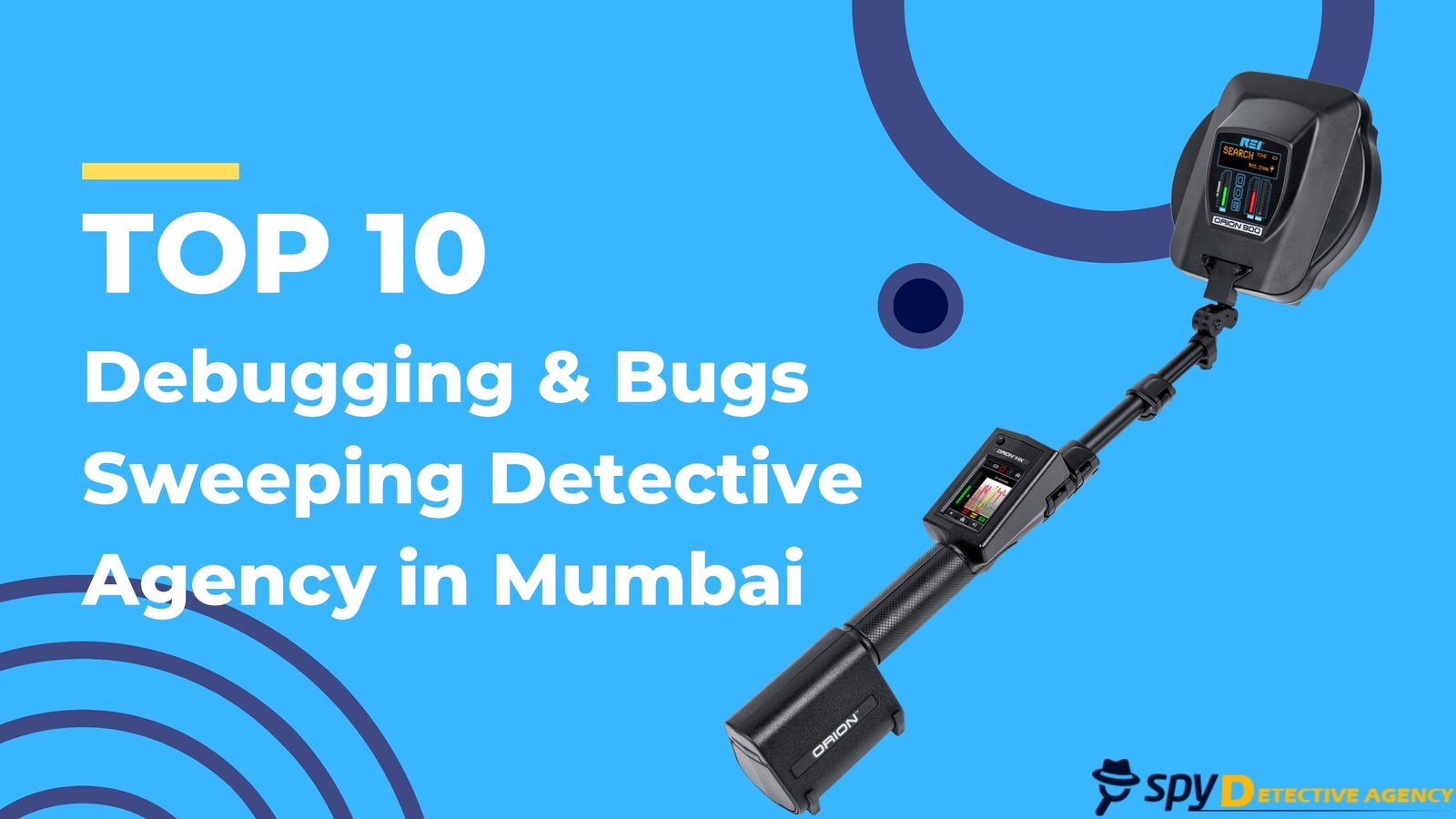
Top 10 bugs sweeping agencies in Mumbai- Updated 2023

Top-10-bugs-sweeping-agencies-in-Mumbai-Updated-2023

In our digital age, the protection of confidential information has become more critical than ever before. As businesses rely on technology more and more to carry out their day-to-day operations, it is essential to ensure that any potential data breaches are detected and prevented.

This is where Technical Surveillance Countermeasures (TSCM) comes in, and the need for such services is increasing in India. In simple words it’s also called electronic debugging and bugs sweep service in Mumbai, TSCM services offer specialized protection against electronic eavesdropping by detecting and neutralizing these types of attacks. With cyber espionage and data breaches becoming an ever-present threat to businesses, TSCM services play a vital role in safeguarding against information theft. In order to stay competitive in today’s digital landscape, businesses need to remain vigilant against potential data breaches. Partnering with a TSCM service provider can provide businesses in India with the advanced tools and techniques required to detect and eradicate any instances of electronic eavesdropping.

The importance of TSCM services in India cannot be overstated, especially as businesses rely heavily on technology to carry out day-to-day operations. TSCM services offer a critical layer of protection against electronic eavesdropping, cyber espionage, and data breaches. Hence, businesses in India must consider investing in TSCM services to ensure the confidentiality and security of their sensitive information.

These are the top 10 debugging and bugs sweeping detective agencies in Mumbai

  1. Spy Detective Agency

Your heard right. Yes Spy Detective Agency. Most of you must have heard the name of our spy detective agency only for personal investigation, corporate investigation, cyber investigation or forensics. But let us tell you that Spy Detective Agency is considered to be the best TSCM Security, Debugging and Bug sweeping company in 2023. Spy Detective Agency is considered the best because only they have the latest technology equipment’s. Which is capable of catching any kind of hidden audio transmitters or spy cameras, either off or on.

Within a short span of time, Spy Detective Agency has carved a niche for itself in TSCM Security, for which it is being recognized all over the world. Not only individuals or companies, big government agencies have also started recognizing Spy Detective Agency for their work.

Do you want to know about those equipment’s and technology, Because of which Spy Detective Agency is being given the title of Top 1 Debugging and Bugs sweeping Detective Agency in Mumbai?

Visit: Debugging and Bugs sweep Detectives in Mumbai

2. Trace Point India Private Limited

Trace Point India is considered one of the best Task Service Provider Company in Delhi.This company, which is known for its limited service, is equipped with very modern equipment and technology.Trace Point India deals in Debugging and Bug Sweeping in TSCM Security as well as Counter Surveillance, Background Check and Data Recovery. Some very different things can also be seen in Trace Point India, such as speech protectors or encrypted phones.Trace Point India always keeps your privacy confidential that’s why it is Top 2 Debugging & Bugs Sweeping Detective Agency in Mumbai.

3. Spy Investigation Agency

Spy Investigation agency is a New Delhi based private detective agency provides TSCM service in India. With more than 10+ years of experience they are the expert of bugs sweep and debugging in India. They provide service in Delhi, Mumbai, Bangalore, Hyderabad, Pune, Chandigarh, Jaipur, Kolkata, Gujarat, Rajasthan, Noida, Faridabad, Kerala, Goa and every small are and major cities in India.

4. Confidential Detective Agency

Confidential in known for the best detective agency in India, They are known to be the largest group or private investigators in India, They also do bugs sweep services in Delhi, Mumbai, Bangalore, Hyderabad, Pune, Chandigarh, Jaipur, Kolkata, Gujarat, Rajasthan, Noida, Faridabad, Kerala, Goa and every states of India.

5. Advance Detective Agency

ADA is one of the most popular private investigation agency in India who provide debugging service to individuals and corporates. It’s a 5 years old company and doing very well in its field.

6. Royal Detective Agency

Debugging and Sweeping Services in Delhi NCR- Royal Detective Agency is the leading private detective agency offering debugging and sweeping services in Delhi.

7. DDS

DDS provides its services of debugging and sweeping in entire India, noticeable amongst them are Delhi, Kolkata, Gurgaon, Noida, Mumbai, Ahmedabad, Surat.

8. Top Indian Detective Agency

At TIDA we are dedicated to providing the highest level of debugging services and bug-swapping in the shortest time possible.

9. Greaves

Debugging is an important part of TSCM and uses extremely sophisticated techniques and methods to find and deactivate the electronic bugs.

10. City Intelligence

Debugging Cars, Houses, Offices Detective Agency in Delhi · Why Debugging services are necessary these days? · Debugging is the act of removing hidden camera.

Here are the top 10 debugging and bugs sweeping detective agencies in Mumbai, so now you need to worry about any kind of electronic bug, spy camera or hidden camera’s because we have the best experts in Mumbai only.

Need of Surveillance Investigation in India

Need of Surveillance Investigation in India

Today in this blog of Spy Detective Agency, I will explain about Need of Surveillance Investigation in India. We are Specialized Private Detectives to solve Surveillance investigation without any delay.  Surveillance is the certified tracking of a suspected person, places, and vehicles, which Private Detectives agencies in Delhi use to investigate an accusation of illicit activity. These Surveillance techniques vary from physical observation to the electronic monitoring of conversations.

There has been a massive increase in fraud cases in our daily life, so faceoff with these cases. Surveillance also carries major life risks, however. The recognition of Private Detectives in Delhi’s presence in an area will not be better in the way for his/her future activities at the location. Being undercover officers, revealing their identity and purpose may lead to drastic consequences for them.

Different types of Surveillance are:

  1. Electronic Surveillance: Electronic monitoring, or wiretapping, refers to the surveillance of email, fax, and telephone communications. When a case is assigned to Spy Detective Agency, we only reveal the truth with proof and facts.
  2. Fixed Surveillance: The fixed surveillance requires detectives to focus observes the suspect and take the position from a safe place and distance. We allow investigators to systematically switch positions, reducing the chances of revealing investigators spotting through anybody.
  3. Stationary Technical Surveillance: In Stationary technical surveillance, the investigator installs a hidden camera and recording equipment in a parked vehicle or any corner of the suspected room or house. The conveyance places in an area that draws little attention, such as a parking lot. We take photos and record videos of suspects at any time, reducing the need for humans to monitor a situation around the clock. Our surveillance teams are experts in solving various types of investigations related to surveillance.
  4. Three-Person Surveillance: Three-person surveillance is an effective technique to keep an eye on the suspect person. An investigator stays behind the suspect, followed by the second investigator. The third Investigator remains on the opposite side of the street, but always moves slightly ahead of or behind the suspect to know about the exact activity. The major motive behind this split surveillance is not to miss out on a single movement from either of the suspects.
  5. Undercover Operations: The undercover operation is a type of surveillance in which our private investigator infiltrates the group by involves in hobbies or jobs like suspects to know about the details of suspicious people and gather proof against the suspect person. The Investigator must also create a fabricated cover story that explains his qualify in the suspect person’s field.

Spy Detective agency is one of the reputed investigation agencies that has an expert team of investigators that are expertise in conducting Surveillance investigation in India and provide evidence with the authentication to our clients within the given timeline.

We are India’s Local Detective Agency from your own State & City, the specially selected tough & experts intelligent he and the agents. Our main strength is Private Investigations in the Indian cities of Mumbai, Jaipur, Kolkata, Bangalore, Chandigarh, Ludhiana, Surat, Amritsar, Noida, Meerut, Nainital, Kanpur, Gurgaon, Goa, Hyderabad.

Spy Detective Agency is the best Private Investigator in Delhi that  Provides Personal Investigations like Pre/Post Matrimonial Investigation, Cheating Spouse Investigation, and Divorce case Investigation, Loyalty Test, Surveillance Investigation, etc., and Corporate Investigations like Pre Employee Verification, Debugging, Asset Verification, and Intellectual Property Rights and many more services all over India at affordable rates. Spy Detective agency in providing quality investigation service in India. Mr. Rohit Malik is the director of the company and his young and dynamic and experienced male and female investigators have already created their name in his fertility. We are having a team of over 100+ highly professional investigators, who are operating globally and delivering the best results to our clients.

For more information click on the below links:

Visit Spy Detective Agency

Visit Confidential Detective Agency

Contact No-9999335950