

Trusted Detective Agency in India – Why Professional Investigative Services Matter

Trusted Detective Agency in India

If you’re searching for a trusted detective agency in India, you’re probably dealing with a decision that can’t wait—an unexplained leak at work, a vendor who doesn’t add up, a property dispute that’s turned murky, or a deeply personal matter that needs clear answers. In moments like these, “good enough” isn’t good enough. You need facts gathered quietly, legally, and with care.

Type “trusted detective agency India” into Google and you’ll see a mix of promises. The reality is simpler: a trustworthy agency listens first, scopes the job clearly, works within the law, and gives you a report you can act on. No drama. No shortcuts.

Why demand is growing

  • Work has gone hybrid. It’s harder to spot insider risk, policy violations, or asset misuse when teams are distributed.
  • Our lives are more digital. Disputes now hinge on devices, cloud accounts, and online footprints.
  • Hiring and partnerships move fast. Background checks and vendor due diligence save costly mistakes.
  • Safety concerns are real. Hidden cameras, GPS trackers, and digital harassment do happen—and need proper handling.
  • Family and property disputes are more complex. Matrimonial verification, custody‑related fact‑finding, and NRI property issues require careful, lawful documentation.

👉 Hire the Best Detective Agency in Delhi for Discreet, Lawful, and Reliable Investigations.

What a trusted agency actually does

Think of a professional agency as your fact‑finding partner. They’ll:

  • Understand your goal. What decision do you need to make? What’s the risk if you get it wrong?
  • Build a plan you approve. Scope, methods, timeline, and updates are written down—no surprises.
  • Collect information the right way. That can include discreet enquiries, site visits, open‑source research (OSINT), lawful surveillance, basic device/network triage (with consent), or a technical sweep for hidden cameras/bugs when needed.
  • Cross‑check everything. Independent sources, records, timestamps, and photos keep mistakes out.
  • Report like adults. Clear findings you can use, with annexures and next‑step recommendations. If evidence might go to court, it’s documented with chain‑of‑custody.

Corporate investigations: common scenarios

  • Background verification at scale: identity, education, employment, references (and criminal checks where legally accessible).
  • Vendor/M&A due diligence: ownership, litigation, sanctions/adverse media, financial and site validation.
  • Internal fraud or leaks: quiet fact‑finding before HR/legal action; preserve devices and data correctly.
  • IP and counterfeit checks: identify and document infringement for takedowns or legal steps.
    What you get: a decision‑grade report and a plan—what to escalate, what to fix, and what to monitor.

Personal matters: handled with discretion

  • Pre‑/post‑matrimonial fact‑finding within legal limits
  • Missing persons and witness location
  • Property/tenancy verification and lawful asset discovery
  • Hidden camera detection, tracker scans, and documentation of digital harassment (with the right consents)
    What you get: clarity and documentation you can share with counsel—or simply the peace of mind to move forward.

Legal and ethical boundaries

Good agencies work inside the law. That means:

  • No illegal interception of calls or messages. No “CDRs.” No hacking. Ever.
  • Respect for privacy rights and data protection (DPDP Act 2023).
  • Evidence handled in ways your lawyer can stand behind.
    If someone offers hacked data or call records, walk away. It’s illegal—and risky for you.

How a professional investigation works (step‑by‑step)

  1. Private intake. You explain the situation; they ask careful questions to define the objective and boundaries.
  2. Written scope. You approve methods, timelines, updates, and fees before anything starts.
  3. Collection. Discreet enquiries, site checks, OSINT, lawful observation, and technical work (e.g., hidden camera sweeps) if needed.
  4. Verification. Multiple sources confirm the same facts.
  5. Reporting. Clear summary, details in annexures, photos/timestamps, and recommended next steps.
  6. Handoff. If required, they coordinate with your lawyer, HR, or security. Some cases include short‑term monitoring.

Costs and timelines—what’s realistic

  • Background checks: often a few days to a week, depending on records and locations.
  • Vendor due diligence: roughly one to two weeks, deeper checks take longer.
  • Sensitive corporate or personal cases: phased over several weeks with milestones.
    Pricing depends on scope. Fixed fees suit defined checks; day rates or retainers fit open‑ended or multi‑city work. A trustworthy agency explains this in writing before you commit.

How to choose a trusted detective agency in India

Use this simple five‑question test:

  • Can they explain—clearly—what they will and won’t do under Indian law?
  • Do they share a written scope, timeline, and update cadence before starting?
  • Will they provide a sample (redacted) report so you can see the quality?
  • Do they have relevant experience (corporate and/or personal) and coverage in your city?
  • Can they describe how they protect your identity and data—NDAs, limited access, code‑named projects?
    If the answer to any of these is fuzzy, keep looking.

Myths to ignore

  • “A quick internet search is enough.” Real cases need fieldwork and verification.
  • “Everyone uses CDRs or hacking.” No—those are illegal. Reputable agencies refuse them.
  • “Surveillance solves everything.” Often, interviews, records, and targeted observation together tell the story.

👉 Hire the Best Detective Agency in Mumbai to Get Facts, Not Assumptions – 100% Confidential Services.

FAQs

Q. Are private detective agencies legal in India?
Yes—when they follow the law and avoid illegal interception or hacking. The good ones are very clear about this.

Q. Will the evidence hold up?
If it’s collected properly and documented with chain‑of‑custody, it can support legal matters. Your counsel will advise on admissibility.

Q. Do agencies work nationwide?
Many have vetted associates in major metros and Tier‑2 cities, coordinated by a single case lead.

Q. How private is this, really?
True professionals operate on a need‑to‑know basis with NDAs, limited access to case files, and code names for sensitive projects.

Q. Can you help with hidden cameras or trackers?
Yes—credible teams can run technical sweeps (bug/hidden camera detection) and handle any finds with proper documentation.

Ready to move forward?

If you need a sounding board before you make a decision, schedule a confidential consultation with a trusted detective agency in India. Ask them to walk you through scope, methods, timelines, and fees in writing. The right partner will make you feel informed, not rushed.

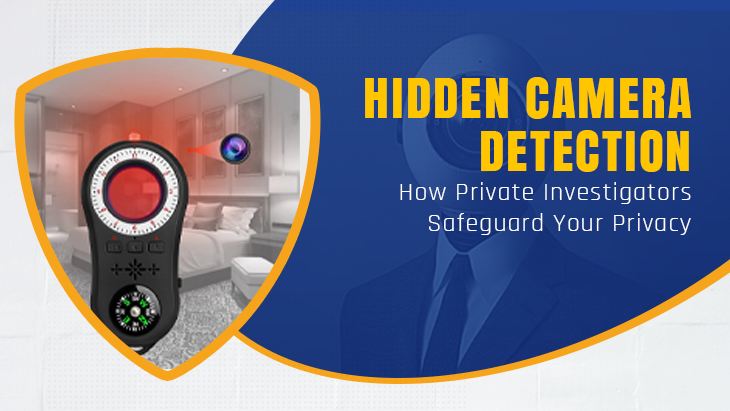
Hidden Camera Detection: How Private Investigators Safeguard Your Privacy

Hidden Camera Detection

Compact, cloud‑connected cameras are cheap, discreet, and everywhere. From rentals and hotel rooms to offices and dressing areas, a single hidden camera can violate privacy, expose trade secrets, or jeopardize safety. Private investigators trained in Technical Surveillance Counter‑Measures (TSCM) conduct discreet, end‑to‑end sweeps to find and neutralize covert cameras—and harden your space so threats don’t return.

This article is for general education, not legal advice. Surveillance and counter‑surveillance laws vary by jurisdiction. If you suspect criminal activity or immediate danger, contact local law enforcement.

Hidden camera detection is more than shining a flashlight. Pros combine physical inspection, optical lens detection, RF spectrum analysis, non‑linear junction detection (NLJD), thermal/power checks, and network audits—plus chain‑of‑custody reporting. Use DIY checks for a quick pass; rely on professional sweeps for certainty and legal‑grade documentation.

What is hidden camera detection?

Hidden camera detection is the systematic process of finding covert video devices—wired or wireless, recording locally or streaming over networks—and safely removing or neutralizing them. Professional TSCM teams layer methods to catch devices that are:

  • Wireless (Wi‑Fi, cellular, analog)
  • Wired (PoE/IP cameras, disguised cabling)
  • Dormant (recording to SD card with no live transmission)
  • Triggered (motion‑activated, packet‑burst, or timer‑based)

Why it matters

  • Personal safety and dignity: Bedrooms, bathrooms, changing areas, rentals, hotel rooms.
  • Corporate confidentiality: Boardrooms, R&D labs, legal war rooms, executive suites.
  • Legal and financial risk: A single leak can damage cases, relationships, brand trust, and valuation.

Common concealment sites

Professionals prioritize high‑yield areas and objects that “belong” in a room:

  • Smoke/CO detectors, motion sensors, air purifiers
  • Alarm clocks, desk clocks, picture frames, wall hooks
  • USB chargers, multi‑plugs, bulbs, light switches
  • Vents, ceiling tiles, thermostats, sprinklers
  • Mirrors (especially in bathrooms/bedrooms), TV bezels, set‑top boxes
  • Soft furnishings (tissue boxes, plants, décor)
  • In offices: conference phones, projectors, HDMI extenders, cable runs

Signs you may be watched

  • New or out‑of‑place devices, adapters, bulbs, cables, or wall plates
  • Tiny pinholes facing beds, showers, desks, or whiteboards
  • Unusual heat from “passive” objects (charger, detector)
  • Rogue Wi‑Fi SSIDs, unfamiliar devices on your network
  • Unexplained leaks of confidential conversations or plans

How private investigators detect hidden cameras (step‑by‑step)

Pre‑brief and OPSEC

  • Discreet intake, scope, floor plans, and threat modeling
  • Prioritize bedrooms/bathrooms, meeting rooms, shared walls, and recent changes

Physical inspection (room by room)

  • Systematic search of ceilings, vents, fixtures, wall plates, furniture, décor
  • Look for tool marks, fresh adhesives, mismatched screws, unusual power taps

Optical and IR lens detection

  • Lens finders/laser reflection in low light to spot pinhole lenses
  • Angled passes around likely sight lines (bed, bath, boardroom table)

RF spectrum analysis

  • Wideband scanning for 2.4/5 GHz Wi‑Fi cameras, sub‑GHz analog transmitters, cellular modules
  • Near‑field probes to localize signals; demodulation checks for video payloads

Non‑linear junction detection (NLJD)

  • Finds hidden electronics—even powered off—inside walls, ceilings, furniture, or objects

Thermal/power analysis

  • Detects heat signatures; flags abnormal loads on mains/PoE that indicate wired IP cameras

Wiring and network audits

  • Trace Ethernet/HDMI/telephony runs; inspect patch panels and PoE switches for rogue devices
  • Network survey: map SSIDs/devices, find default/weak creds, analyze traffic anomalies

Evidence handling and remediation

  • Photograph and isolate devices; maintain chain‑of‑custody
  • Safe removal/neutralization and immediate hardening steps
  • Confidential report with findings, RF logs, timestamps, and remediation plan

Hire the best Detective Agency in Mumbai for professional, discreet debugging and bug-sweeping with state-of-the-art tools and expert service.

Hotel/Airbnb traveler checklist (DIY, safe and quick)

Use this for a quick pass—then call pros if anything looks off.

  • Darken the room; slowly scan with a lens detector or strong flashlight for pinhole reflections aimed at shower/bed/work areas.
  • Inspect common hides: smoke detectors, alarm clocks, USB chargers, wall hooks, vents, TV bezels.
  • Check mirrors at oblique angles with light; look for pinhole lenses near eye‑level.
  • Scan Wi‑Fi with your phone for unfamiliar SSIDs/devices; turn off “auto‑join” on unknown networks.
  • If you find something suspicious: don’t announce it in‑room. Leave, document from a safe location, contact management and law enforcement, and call a professional TSCM team.

Legal and ethical steps if you find a device

  • Do: Move to a safe place before discussing; photograph in situ; preserve timestamps; contact police/platform; engage professionals for evidence‑safe removal.
  • Don’t: Destroy or discard the device; use RF jammers (illegal in many places); confront suspects directly.

Aftercare: hardening your environment

  • Physical: Secure ceiling access, lock AV/IT closets, use tamper‑evident seals
  • Network: Rotate Wi‑Fi keys, segment IoT/guest, disable UPnP, enforce MFA
  • Procedures: Device‑free protocols for sensitive meetings; pre‑meeting room checks
  • Monitoring: Periodic sweeps, spot checks during renovations/staff changes/travel

How to choose a provider

  • Credentials: TSCM training, relevant security certifications (e.g., ASIS CPP/PSP)
  • Equipment and methods: RF, NLJD, optical, thermal, wiring, network, vehicle coverage
  • Independence: Vendor‑neutral; no “spy gadget” sales conflicts
  • Reporting: Chain‑of‑custody, photos, RF logs, clear remediation
  • Discretion and references: Experience with board‑level and high‑profile residential clients
  • Scope and pricing clarity: Defined areas, time on site, disruption plan, follow‑up support

Myths vs reality

  • Myth: “Your phone can find everything.” Reality: Phones miss dormant/wired devices; lens reflection is not foolproof.
  • Myth: “Turn off Wi‑Fi and you’re safe.” Reality: Cameras can record locally to SD or use cellular.
  • Myth: “Cheap detectors are enough.” Reality: Many devices are packet‑burst or hidden in wiring—layered methods are required.
  • Myth: “One sweep fixes it forever.” Reality: Pair sweeps with policies, access control, and periodic checks.

FAQs

Q: Can a phone detect hidden cameras?
A: Phones can help find Wi‑Fi devices and catch some lens reflections, but they won’t reliably detect dormant or wired cameras. Pros use NLJD, RF, optical, thermal, and wiring/network methods.

Q: How do pros find powered‑off cameras?
A: NLJD detects the semiconductor junctions inside electronics—even without power—plus physical and thermal checks to confirm.

Q: Will a sweep damage property?
A: Professional sweeps are non‑destructive. If removal is needed, teams use careful methods and document everything for legal follow‑up.

Q: How long does a hidden camera sweep take?
A: From a few hours (single room/vehicle) to a full day or more (multi‑room homes/offices), depending on size and complexity.

Q: What if I’m in a hotel or rental and suspect a camera?
A: Leave the room, document safely, contact management and police, and call a professional. Avoid touching or powering devices repeatedly.

Ready to secure your space?

Protect your privacy with Spy Detective Agency , the best detective agency in Delhi India.

  • Discreet hidden camera sweeps for homes, rentals, hotels, offices
  • RF, optical, NLJD, wiring, and network checks
  • Legal‑grade reporting and remediation
  • Book a Debugging and Sweeping Services Today!
  • Call/ Whatsapp : +91 – 999 933 5950
    We respond within 1 business day. If you suspect active criminal activity, contact law enforcement immediately.